

Tristan is a name that carries centuries of history and emotion. It originates from Celtic traditions, derived from the word “drustan,” meaning “tumult” or “noise.” The name spread across Europe through the legendary medieval romance of Tristan and Isolde.
Tristan does not have a Greek origin, but it connects naturally to the Greek word “tristos” (τριστός), meaning sad or sorrowful. This link gives the name a deeper emotional layer. It resonates with themes of passion, loyalty, and tragic love, found across both Celtic legend and Greek culture.
What Is the Meaning of Tristan?
The name Tristan is a classic masculine name best known through medieval European literature, especially the legend of Tristan and Isolde. Its exact linguistic origin is debated, with connections proposed to Celtic and medieval European traditions. The name later became associated with ideas of love, loyalty, bravery, and tragic romance.
Although Tristan may appear in discussions about Greek names, Tristan is not traditionally considered a Greek-origin name. Its connection with Greek culture is better understood through later usage, comparisons, and literary interpretation rather than a direct ancient Greek etymology.
Ojos Tristes Meaning
“Ojos tristes” is a Spanish phrase meaning “sad eyes.” It is sometimes associated with Tristan because medieval interpretations connected the name with sadness or sorrow.
However, “Ojos tristes” is not the literal Greek meaning of Tristan. The association comes from interpretation and linguistic traditions surrounding the name rather than from Greek etymology.
Tristan Name Meaning
Tristan is commonly associated with meanings such as sorrowful, sad, or melancholy, although the historical origin of these interpretations is not completely certain.
The name became especially famous through the medieval romance Tristan and Isolde, where Tristan is portrayed as a courageous knight whose story centers on love, loyalty, conflict, and tragedy. Because of this literary tradition, modern interpretations of Tristan often extend beyond its debated linguistic meaning.
Common associations with Tristan
- Love and devotion ❤️
- Courage and bravery
- Loyalty
- Romance
- Strength through hardship
- Adventure
- Emotional depth
Tristan Meaning in Bible
Tristan is not a biblical name and does not appear as a personal name in the Bible.
Its popularity comes primarily from European history and medieval literature rather than biblical tradition. Therefore, Tristan should not be presented as a Hebrew or biblical name based solely on modern interpretations of its meaning. Tristan Meaning in Bible.
Parents looking for a biblical connection may instead explore names with documented Hebrew, Greek, or Aramaic origins.
Tristan Meaning of the Name
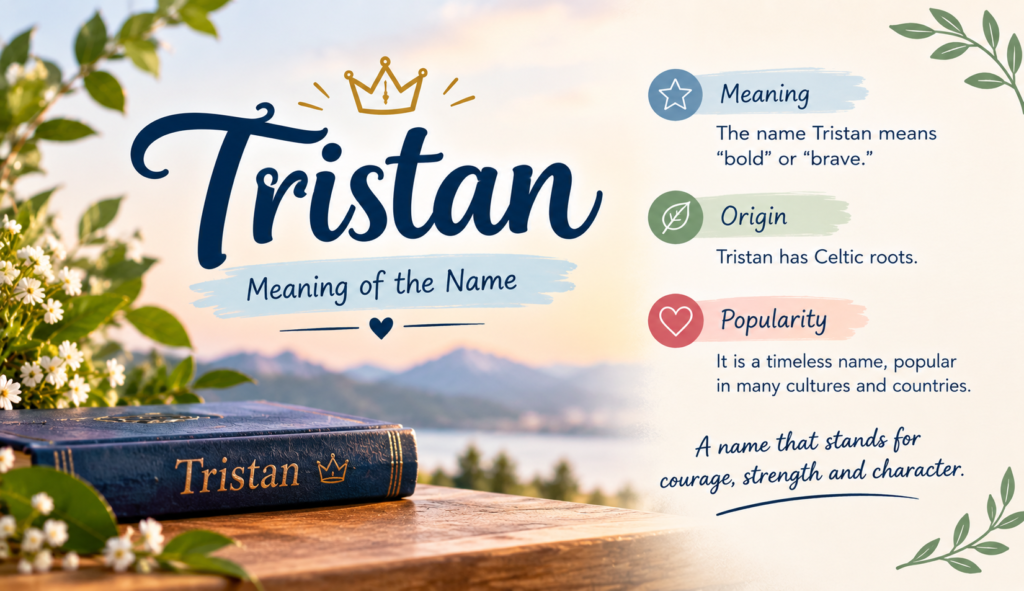
The meaning traditionally associated with Tristan has developed over centuries. Some explanations connect it with ideas of sadness or sorrow, while others examine possible Celtic or medieval linguistic roots.
The strongest cultural influence on the modern perception of Tristan is the medieval story of Tristan and Isolde. Through this legend, the name became strongly connected with romantic love, loyalty, courage, and tragedy.
Tristan Meaning in Greek
Tristan does not have a standard ancient Greek etymology. In Greek-speaking contexts, the name can be used as a modern foreign name, but that does not make it an originally Greek name.
When people search for the “Greek meaning” of Tristan, they may actually be asking about its pronunciation, Greek usage, or whether the name has an ancient Greek origin. These are different questions and should be separated when discussing the name accurately.
The Greek Etymology of Tristan
There is no widely accepted scholarly evidence establishing Tristan as an ancient Greek-origin name. The name is generally discussed in connection with Celtic and medieval European traditions, with its precise etymology remaining debated.
Foundational Linguistic Origins
One commonly discussed explanation connects Tristan with the medieval form Tristram, while another tradition associates the name with a Celtic personal name. Medieval literary adaptations also helped create associations between Tristan and sadness.
Because several explanations exist, it is better to describe Tristan’s origin as historically debated rather than claiming one certain Greek derivation.
The Historical Origin of the Name Tristan
Tristan became famous through medieval European literature, particularly the romance surrounding Tristan and Isolde. The character appears in Arthurian-related traditions as a knight associated with King Mark of Cornwall.
Over time, different writers adapted the story, helping the name spread across Europe. Its literary importance played a major role in transforming Tristan from a medieval personal name into a recognizable modern given name.
Tristan in Greek Mythology and Ancient Stories
Tristan is not a character from classical Greek mythology. Greek mythology includes figures such as Achilles, Odysseus, Perseus, and Theseus, while Tristan belongs primarily to the medieval European literary tradition.
Nevertheless, readers may notice similarities between Tristan’s story and Greek myths because both traditions contain themes involving heroic journeys, complicated relationships, fate, loyalty, and tragedy.
Tristan’s Parallels to Greek Mythology
The comparison is thematic rather than historical. Tristan’s story can be discussed alongside Greek myths because both traditions explore powerful human emotions and difficult choices.
However, these similarities should not be interpreted as evidence that Tristan originated from Greek mythology.
Cultural Significance of Tristan in Greek History
There is no established evidence that Tristan was a significant personal name in ancient Greek history.
Its presence in modern Greek-speaking communities is better understood as part of the adoption and adaptation of international names. This distinction is important when discussing Tristan because modern use does not necessarily indicate ancient Greek origin.
How Ancient Greeks Used the Name?
Ancient Greeks did not traditionally use Tristan as a Greek personal name. The name belongs to a much later European naming tradition.
The Connection Between Tristan and Greek Language
The connection between Tristan and Greek is primarily a matter of modern language usage, pronunciation, and cultural comparison, rather than original etymology.
Linguistic Features
When Tristan is written or pronounced in Greek, its spelling and pronunciation can be adapted to the Greek writing system. This linguistic adaptation allows a foreign name to function naturally within Greek-language contexts without changing its historical origin.
Tristan vs. Greek Names: Similarities and Differences
Tristan can be compared with Greek names based on sound, meaning, or cultural associations, but its historical background is different.
Tristan vs. Greek Names Comparison
| Feature | Tristan | Traditional Greek Names |
| Main origin | Medieval European traditions | Ancient Greek and later Greek traditions |
| Biblical status | Not a biblical name | Some Greek names appear in the New Testament |
| Greek origin | Not traditionally Greek | Greek-origin names have documented Greek roots |
| Literary connection | Tristan and Isolde | Greek mythology and classical literature |
| Common associations | Love, loyalty, sorrow, courage | Varies by individual name |
Modern Usage of Tristan in Greek-Speaking Countries
Today, Tristan can be encountered as an international name in different countries, including places where Greek is spoken. Its modern use should not be confused with ancient Greek naming traditions.
International names can enter a language through migration, media, literature, popular culture, and cross-cultural families. Tristan fits this broader pattern of modern name adoption.
Why Parents Choose Tristan: Greek Heritage Perspective?
Parents may choose Tristan for its international sound, literary history, romantic associations, or personal significance. However, choosing Tristan does not necessarily indicate Greek heritage.
Key Reasons Greek Parents Choose Tristan
Possible reasons include:
- Its international appeal
- Connection with medieval literature
- Romantic associations
- Distinctive sound
- Familiarity across multiple languages
- Personal or family preference
Famous People Named Tristan with Greek Heritage
Several people named Tristan have appeared in public life, entertainment, sports, literature, and other fields. However, having the name Tristan does not itself establish Greek heritage.
When discussing an individual’s heritage, it is important to rely on documented biographical information rather than assuming ancestry from the person’s name.
Tristan Name Variations Across Greek Regions
There is no strong historical basis for identifying Tristan as a traditional Greek regional name with distinct ancient regional forms.
Modern Greek speakers may adapt the pronunciation or written form of international names according to Greek-language conventions. These adaptations represent language usage rather than separate ancient Greek origins.
The Symbolism Behind Tristan in Greek Culture
In a Greek cultural context, Tristan may be interpreted through broader themes associated with its famous literary story, including love, loyalty, courage, sacrifice, and emotional struggle.
These are cultural or literary associations rather than established ancient Greek meanings.
Is Tristan a Popular Name in Greece Today?
The popularity of Tristan in Greece should be evaluated using current Greek naming statistics rather than assumptions based on international popularity.
Because naming trends can change over time, a claim about its current ranking should specify the relevant year and data source.
Tristan’s Role in Greek Literature and Poetry
Tristan is not traditionally part of the classical Greek literary canon. The character belongs primarily to medieval European romance.
Modern writers and readers may nevertheless reference Tristan when exploring universal literary themes such as forbidden love, loyalty, fate, sacrifice, and tragedy.
The Greek Influence on Tristan’s Meaning Over Time
There is no clear historical basis for saying that ancient Greek language directly changed the original meaning of Tristan.
Instead, the name’s meaning has developed through literary interpretation, translation, cultural adaptation, and modern naming practices. Its associations with romance and sorrow are particularly influenced by the Tristan and Isolde tradition.
Is Tristan a Viking Name?
Tristan is not generally classified as a traditional Viking or Old Norse name. Its history is more closely associated with Celtic and medieval European naming traditions.
The confusion may arise because medieval European names sometimes crossed cultural and geographic boundaries, and modern discussions occasionally connect Tristan with various European peoples. A Viking connection, however, should not be presented as the established origin of the name.
What Are the Best Nicknames for Tristan?
Tristan already has a short and distinctive sound, but several informal nicknames can be created from it.
Some possibilities include:
- Tris
- Tristy
- Trist
- T
- Tristan Bear
- Tris-Tris
- Tristie
- T-Man
The best nickname usually depends on the person’s age, personality, and family or friendship circle.
Is Tristan a Rare Name?
Whether Tristan is considered rare depends on the country, year, and population being examined. It is recognizable internationally but is not equally common everywhere.
Its popularity has also been influenced by literature, entertainment, and broader naming trends. Therefore, “rare” should be treated as a relative description rather than a fixed characteristic.
What Does Tristan Mean Spiritually?
Spiritually, Tristan can be interpreted through themes such as love, loyalty, courage, perseverance, and emotional strength.
These spiritual meanings are interpretations rather than established dictionary definitions. Someone choosing the name Tristan may connect it with the idea of remaining loyal and courageous through difficult circumstances.
What Does the Name Tristan Symbolize?
The name Tristan is often symbolically connected with deep love, loyalty, courage, adventure, and resilience.
Its strongest symbolic influence comes from the legendary story of Tristan and Isolde. The tragic nature of that story has also contributed to associations with emotional depth and sorrow — a theme echoed in many heartfelt anniversary messages about love that endures.
Has the Meaning of Tristan Changed Over Time?
The perception of Tristan has changed significantly through different historical periods. Earlier linguistic explanations focused on possible Celtic or medieval roots, while literary tradition gave the name powerful associations with love and tragedy.
In modern naming culture, Tristan is often viewed less as a “sorrowful” name and more as a romantic, strong, sophisticated, and internationally recognizable name.
This shift shows how names can develop meanings through literature and cultural use rather than through etymology alone.
Is Tristan a Biblical or Greek Name? Complete Origin Analysis?
Tristan is neither traditionally a biblical name nor an ancient Greek-origin name. Its strongest historical associations are with medieval European literature and traditions surrounding Tristan and Isolde.
While the name can be used in Greek-speaking communities and written in Greek, modern usage does not change its original historical classification.
Ojos Tristes Meaning

“Ojos tristes” is a Spanish phrase. It simply means “sad eyes.” It comes from the Spanish word “triste,” which means sad or sorrowful — the same root connected to the name Tristan.
Tristan Name Meaning
Tristan is a given name derived from the Welsh word “drust,” meaning “noise” or “tumult.” Over time, the French word “triste” influenced the name, adding the meaning of “sad” or “sorrowful.”
Today, Tristan is understood to mean bold, sorrowful, or noisy — depending on the cultural lens you use. It is a name that carries both strength and emotion.
Tristan Meaning in Bible
Tristan does not appear anywhere in the Bible. It is not found in the Old Testament or the New Testament. Tristan is a name of Celtic and French origin that became popular through medieval European literature, particularly the legend of Tristan and Isolde.
However, the themes behind the name do align with biblical values. Sorrow, endurance, and transformation are all deeply biblical ideas. Many Christian families choose Tristan because its meaning mirrors these spiritual journeys.
Tristan Meaning of the Name
The name Tristan is of Celtic origin and means “outcry” or “sorrowful.” It was made famous by the medieval legend of Tristan and Isolde — a tragic love story that touched hearts across Europe.
In Latin, the name connects to “tristis,” meaning full of sorrow. In Welsh, it means noisy. In Arthurian legend, it means a knight — brave, loyal, and noble.
Tristan Meaning in Greek

Tristan does not have a direct Greek origin. The name does not originate from the Greek language or ancient Hellenic culture — it is purely Celtic in origin, derived from the Pictish name “Drust” or “Drustan.” It can only be transliterated phonetically as Τρίσταν using Greek letters to approximate the sound.
However, the name connects spiritually to Greek ideas. The Greek word “tristos” means sad. That link gives Tristan a Greek emotional resonance even without a direct translation.
The Greek Etymology of Tristan
Foundational Linguistic Origins
Tristan’s roots begin in Celtic and Brythonic languages. The original form was “Drustanus” — a Pictish name. It traveled through Welsh, Latin, and French before becoming the Tristan we know today.
Greek did not shape the name directly. But Greek culture values similar themes — tragedy, love, and heroic endurance. These themes connect Tristan to the Greek worldview naturally.
The Historical Origin of the Name Tristan

The name is derived from the Celtic name “Drustanus,” which is composed of two elements: “drust” meaning “sadness” and the suffix meaning “fierce.”
The name evolved through medieval French storytelling. It became famous through the tragic romance of Tristan and Iseult — a story of forbidden love and noble sacrifice.
That story spread across Europe. It was retold in French, German, and English literature for centuries. It even inspired Richard Wagner’s famous 1859 opera.
Tristan in Greek Mythology and Ancient Stories
Tristan’s Parallels to Greek Mythology
Tristan is not a figure from Greek mythology. But his story mirrors many Greek myths. The theme of a hero torn between duty and love is very Greek in nature.
Think of Orpheus and Eurydice. Think of Paris and Helen. These stories share the same emotional core as Tristan and Iseult. Love, loss, and fate — timeless Greek themes.
The tragic ending of Tristan’s story would feel very familiar to any ancient Greek storyteller. Fate always wins. That is a Greek idea too.
Cultural Significance of Tristan in Greek History
How Ancient Greeks Used the Name?
Ancient Greeks did not use the name Tristan. It arrived in Europe much later through Celtic and medieval traditions.
But as Greek culture spread across Europe over time, names like Tristan were absorbed into a broader cultural conversation. Greek philosophers valued emotional depth and noble suffering — both qualities Tristan’s story embodies.
The Connection Between Tristan and Greek Language
Linguistic Features
In Greek, the word “tristos” (τριστός) relates to sadness. This is not the direct origin of Tristan, but it creates a natural linguistic bridge.
When Greek speakers encounter the name Tristan, the phonetic similarity to “tristos” gives it an intuitive emotional meaning. It sounds like a word they already know. That connection, even if indirect, is linguistically significant.
Tristan vs. Greek Names: Similarities and Differences
Tristan vs. Greek Names Comparison
| Feature | Tristan | Typical Greek Name |
| Language origin | Celtic / Welsh | Ancient Greek |
| Core meaning | Sorrow / noise / bold | Varies (virtue, god, nature) |
| Mythology link | Arthurian legend | Greek mythology |
| Ending pattern | -an (common in Celtic names) | -os, -as, -is (Greek suffixes) |
| Emotional tone | Melancholic, heroic | Often triumphant, divine |
| Modern usage | Global, popular in West | Common in Greece and diaspora |
Modern Usage of Tristan in Greek-Speaking Countries
Tristan is not a traditional Greek name. But it is used in modern Greece, especially in urban and cosmopolitan families.
Tristan is moderately popular in many Western countries. It appears regularly on boys’ name lists across Anglophone countries and parts of Europe. Greek parents who have traveled or studied abroad often bring back names like Tristan.
It is seen as a sophisticated European name with a romantic, literary background. That reputation appeals to educated, globally minded Greek families.
Why Parents Choose Tristan: Greek Heritage Perspective?
Key Reasons Greek Parents Choose Tristan
- It sounds elegant and European
- It carries a romantic literary history
- It is easy to pronounce in Greek
- The phonetic link to “tristos” gives it emotional depth
- It blends well with Greek surnames
- It works across multiple languages without sounding foreign
- It has a noble, knightly association that Greek culture admires
Famous People Named Tristan with Greek Heritage
No widely documented famous Greeks bear the name Tristan as their primary given name. However, Greek-born individuals living in diaspora communities in France, the UK, and the US have given this name to their children.
Famous Tristans include actor Chris Hemsworth, who named one of his twin sons Tristan in 2014, and NBA player Tristan Thompson. These cultural touchpoints have influenced Greek parents globally.
Tristan Name Variations Across Greek Regions
The name adapts naturally across different European languages, and Greek speakers use similar phonetic variations:
- Greek transliteration: Τρίσταν (Tristan)
- Portuguese version: Tristão
- Spanish version: Tristán
- French version: Tristan (unchanged)
- Welsh/Cornish: Tristram
- Latin form: Tristanus
In Greece, the name is written and pronounced as “Tristan” without modification, keeping its Western European identity intact.
The Symbolism Behind Tristan in Greek Culture
In Greek thought, names carry symbolic weight. The idea of a name meaning “sorrow” is not negative — it is profound.
Greek tragedy celebrates the noble hero who suffers. Tristan fits that archetype perfectly. He loves deeply, suffers greatly, and remains loyal until the end.
To a Greek mind, that is not a weak name. That is a heroic one. Sorrow in Greek culture often signals greatness, depth, and a meaningful life lived fully.How to Pronounce Tristan in Greek
In Greek, Tristan is pronounced: TRIS-tan (ΤΡΙΣ-ταν).
- First syllable: “TRIS” — short, sharp, like “twist” without the w
- Second syllable: “tan” — soft, like the English word “tan”
The Greek pronunciation stays very close to the English version. There is no significant phonetic shift when the name moves into Greek. That ease of pronunciation is one reason it travels well internationally.
Is Tristan a Popular Name in Greece Today?

Tristan is not among the top traditional Greek names. Names like Nikos, Giorgos, Dimitris, and Alexis dominate Greek baby name lists.
However, in international Greek communities and among younger urban parents in Athens and Thessaloniki, Western names including Tristan are growing in use. It signals a cosmopolitan, European identity without abandoning classic naming traditions entirely.
Tristan’s Role in Greek Literature and Poetry
Tristan does not appear in ancient Greek literature. Homer, Sophocles, and Plato never wrote about him.
But the medieval romance of Tristan and Iseult was translated and read across Europe — including in Greek-speaking Byzantine and post-Byzantine regions. The story’s emotional themes of doomed love and noble sacrifice spoke directly to the Greek literary tradition of tragedy.
Modern Greek poets have referenced Tristan as a symbol of romantic suffering. The name carries poetic weight in contemporary Greek creative writing.
The Greek Influence on Tristan’s Meaning Over Time
Greek philosophy has enriched how we understand the name Tristan over centuries. The Greek concept of “pathos” — deep emotional suffering — maps perfectly onto Tristan’s story.
Greek culture also values “arete” — excellence and virtue through struggle. Tristan embodies this. He is not sad without purpose. His sorrow comes from loving deeply and living nobly.
Over time, the Greek intellectual tradition has quietly added philosophical depth to a name that began as a simple Celtic word for noise. That is the power of cultural layering.
Is Tristan a Biblical or Greek Name? Complete Origin Analysis?

The answer is clear: Tristan is neither a biblical name nor a Greek name.
Tristan has no meaning in Greek because the name does not originate from the Greek language or ancient Hellenic culture. It is purely Celtic in origin, derived from the Pictish name “Drust” or “Drustan.”
It is also not found anywhere in the Bible — not in Hebrew scripture nor in the New Testament Greek writings.
Here is the full origin breakdown:
| Category | Does Tristan Belong? | Notes |
| Celtic / Welsh origin | Yes — primary origin | From “Drust” meaning noise/tumult |
| French influence | Yes — secondary layer | “Triste” meaning sad added meaning |
| Latin influence | Yes — tertiary layer | “Tristis” meaning sorrowful |
| Greek origin | No — not a Greek name | Phonetic similarity only |
| Biblical name | No — not in scripture | Medieval European origin |
| Hebrew origin | No — no direct link | Spiritual themes connect loosely |
| Arthurian legend | Yes — popularized here | Tristan and Isolde romance |
| Christian usage | Yes — widely used | Symbolizes faith through suffering |
Tristan is a Celtic name with French and Latin refinement. Its journey through European culture gave it Greek resonance and Christian spiritual depth. It carries all of these layers at once — which is exactly why it has endured for more than a thousand years.
Frequently Asked Questions
What does the name Tristan mean in Greek?
Tristan is not a Greek name. But it connects to the Greek word “tristos,” meaning sad or sorrowful. That link gives it a natural Greek emotional meaning.
Where does the name Tristan originally come from?
Tristan comes from Celtic and Welsh roots. It is derived from the old Pictish word “Drust,” meaning noise or tumult.
Is Tristan a name found in the Bible?
No, Tristan does not appear anywhere in the Bible. It is a medieval European name, not a biblical one.
What is the meaning of Tristan in Hebrew?
Tristan has no direct Hebrew meaning. However, its themes of sorrow and endurance connect loosely to Hebrew spiritual values of faith through suffering.
How do you pronounce Tristan in Greek?
In Greek, Tristan is pronounced TRIS-tan and written as Τρίσταν. The pronunciation stays very close to the English version.
Is Tristan a popular name in Greece today?
Tristan is not a traditional Greek name. But modern Greek parents in cities and diaspora communities are choosing it more often for its romantic, European feel.
Is Tristan a Greek or Celtic name?
Tristan is purely Celtic in origin. It has no direct Greek roots, though its sound and meaning create a natural connection to Greek language and culture.
conclusion
Tristan is not a Greek name — but its meaning fits perfectly into Greek culture. It carries themes of sorrow, heroism, and deep emotion. Those are values the ancient Greeks understood and celebrated for centuries.
The name began in Celtic tradition and traveled through French, Latin, and European literature to reach us today. Every culture it touched added something new to its meaning. That layered history is exactly what makes Tristan a name worth knowing.

I am Brinley, a writer who loves sharing blessings and positive words. I have three years of experience creating meaningful blessings for readers. Nich is the creative mind behind many trending blessings and prayers. Our goal is to spread faith, hope, and kindness online.