

Every year on July 20, people around the world celebrate Moon Day, a special occasion that honors one of humanity’s greatest achievementsf the first successful Moon landing by Apollo 11 in 1969. On this historic day, astronaut Neil Armstrong became the first person to walk on the Moon, followed shortly by Buzz Aldrin, forever changing the course of space exploration.
Moon Day is more than just remembering a historic event. It celebrates scientific discovery, human curiosity, innovation, and the dream of exploring worlds beyond Earth. In recent years, interest in Moon Day has grown because of new lunar missions, NASA’s Artemis program, and increasing global interest in returning humans to the Moon.
If inspiring historical achievements motivate you, you may also enjoy our collection of Inspirational Morning Messages to start each day with purpose.
What Is Moon Day?
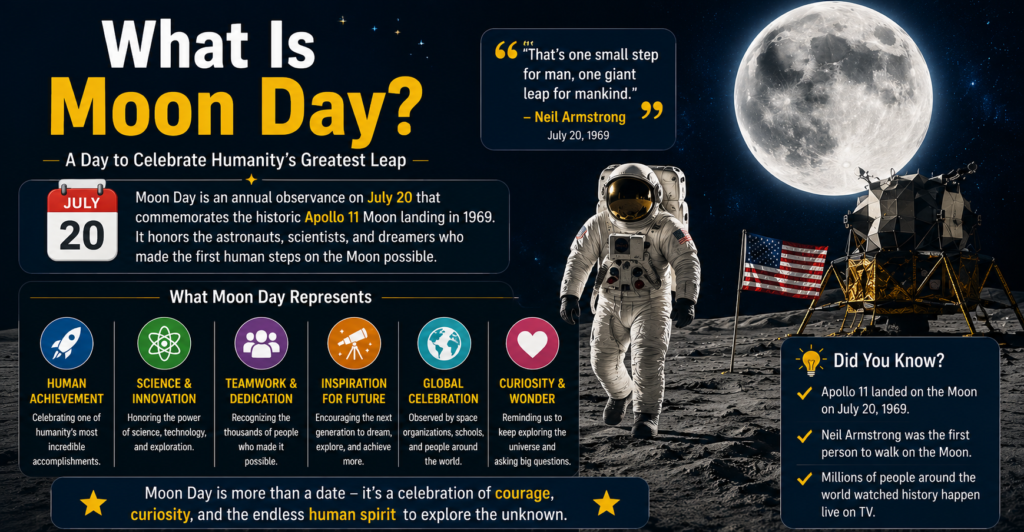
Moon Day is an annual observance celebrated on July 20 to commemorate the day when Apollo 11 successfully landed on the Moon in 1969. It recognizes one of the greatest milestones in human history and honors the scientists, engineers, astronauts, and support teams who made lunar exploration possible.
Like many meaningful observances, Moon Day encourages hope and gratitude. You can also explore our Daily Blessings for everyday inspiration.
The day reminds us that human determination, scientific innovation, and international curiosity can achieve what once seemed impossible.
Today, Moon Day is recognized by:
- Space organizations
- Science museums
- Schools and universities
- Astronomy clubs
- Space enthusiasts
- Educators and students worldwide
Many people also celebrate by learning about space exploration, watching documentaries, observing the Moon through telescopes, and sharing interesting Moon facts online.
Why Is Moon Day Celebrated on July 20?
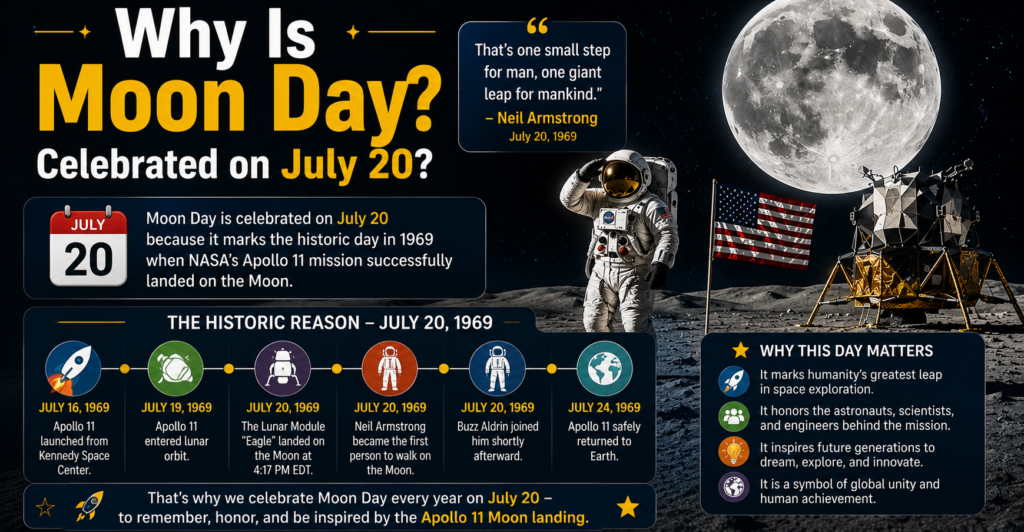
Moon Day is celebrated on July 20 because this is the date when Apollo 11’s Lunar Module “Eagle” successfully landed on the Moon in 1969.
This event marked the first time humans reached another celestial body.
Key Milestones
- Apollo 11 launched on July 16, 1969
- Lunar Module Eagle landed on July 20, 1969
- Neil Armstrong became the first human to walk on the Moon
- Buzz Aldrin followed shortly afterward
- Michael Collins remained in lunar orbit aboard the Command Module
Neil Armstrong’s famous words—
“That’s one small step for man, one giant leap for mankind.”
—became one of the most iconic quotes in history.
Because of this achievement, July 20 is celebrated worldwide as Moon Day.
Moon Day Meaning Explained
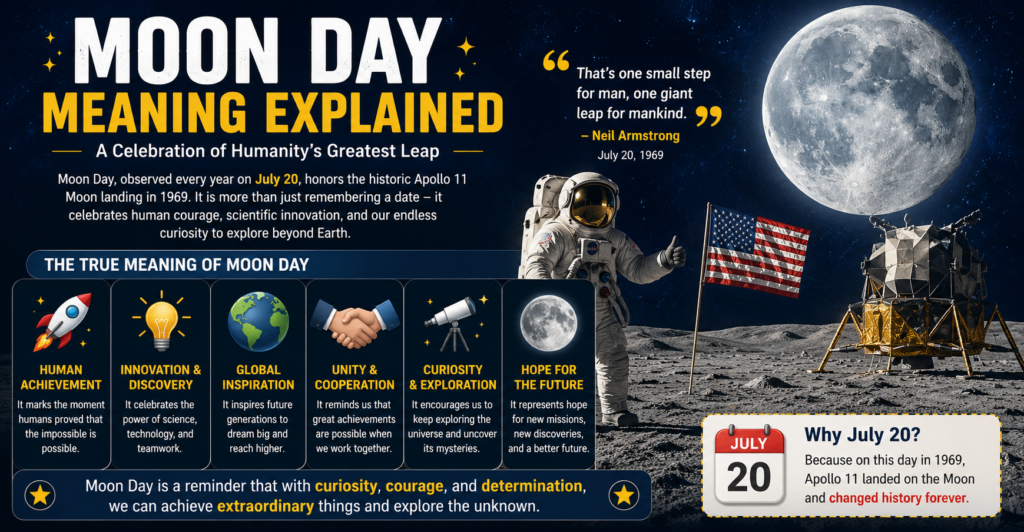
The meaning of Moon Day goes far beyond remembering a historical event.
Moon Day reminds us that freedom, courage, and discovery can shape history. You may also like reading about /the-blessings-of-liberty/
It symbolizes:
- Human courage
- Scientific achievement
- Innovation
- Space exploration
- Curiosity about the universe
- International cooperation
- Future exploration of Mars and beyond
For many people, Moon Day also serves as inspiration for students interested in science, engineering, astronomy, and technology.
It reminds us that great discoveries begin with curiosity and determination.
The History of Moon Day and Apollo 11
During the 1960s, the United States and the Soviet Union competed in what became known as the Space Race.
After President John F. Kennedy challenged America to land a man on the Moon before the end of the decade, NASA began preparing one of the most ambitious missions ever attempted.
Apollo 11 became that historic mission.
Apollo 11 Crew
- Neil Armstrong — Commander
- Buzz Aldrin — Lunar Module Pilot
- Michael Collins — Command Module Pilot
After traveling nearly 240,000 miles (386,000 km) from Earth, Apollo 11 entered lunar orbit.
On July 20, the Lunar Module Eagle separated from the Command Module and safely landed on the Moon’s surface in the Sea of Tranquility.
Neil Armstrong stepped onto the Moon first, followed by Buzz Aldrin.
Together they:
- Collected Moon rocks and soil samples
- Conducted scientific experiments
- Planted the United States flag
- Took photographs
- Explored the lunar surface
The astronauts later returned safely to Earth on July 24, 1969, completing one of history’s greatest scientific missions.
When Was the First Moon Day?
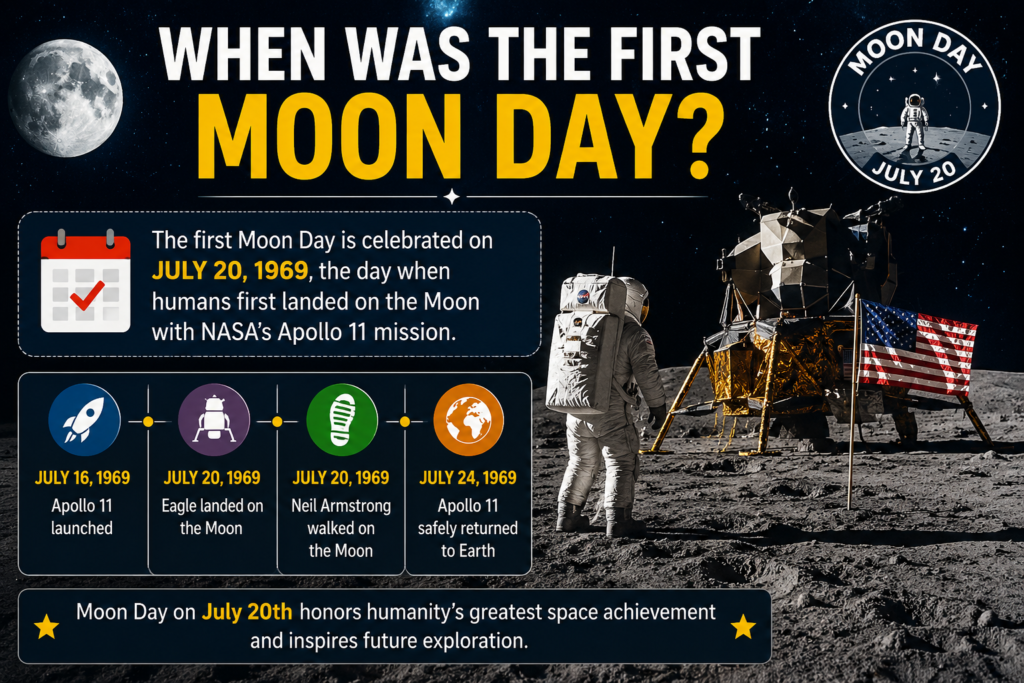
The first Moon Day is directly connected to the historic Apollo 11 Moon landing on July 20, 1969, when humans first reached the Moon. Since then, July 20 has become a day to recognize this incredible achievement in space exploration.
In the United States, Moon Day has long been observed as a commemorative day celebrating the success of Apollo 11. In 2021, the United Nations officially established International Moon Day, which is celebrated every year on July 20 to honor the anniversary of humanity’s first lunar landing and encourage peaceful cooperation in space exploration.
Quick Answer
- First Moon landing: July 20, 1969
- Apollo mission: Apollo 11
- Official International Moon Day: Established in 2021
- Celebrated annually: July 20
Although the observance has evolved over time, the date has always remained the same because it marks one of humanity’s greatest scientific achievements.
What Happened on July 20, 1969?
On July 20, 1969, the world watched as NASA’s Apollo 11 mission successfully landed on the Moon.
Millions of people followed the mission on television and radio, witnessing history unfold in real time.
Historic Events of July 20, 1969
- Apollo 11 entered lunar orbit.
- The Lunar Module Eagle separated from the Command Module.
- Neil Armstrong and Buzz Aldrin descended toward the Moon.
- Eagle safely landed in the Sea of Tranquility.
- Neil Armstrong became the first human to step onto the lunar surface.
- Buzz Aldrin joined him a short time later.
- The astronauts conducted scientific experiments and collected lunar samples.
- They returned safely to Earth a few days later.
The success of Apollo 11 proved that human space travel could accomplish extraordinary goals and opened the door for future lunar exploration.
Moon Day 1969 Timeline
Understanding the Apollo 11 mission helps explain why Moon Day is celebrated every year.
| Date | Event |
| July 16, 1969 | Apollo 11 launched from Kennedy Space Center |
| July 19, 1969 | Spacecraft entered lunar orbit |
| July 20, 1969 | Eagle landed on the Moon |
| July 20, 1969 | Neil Armstrong became the first person to walk on the Moon |
| July 20, 1969 | Buzz Aldrin joined Armstrong on the lunar surface |
| July 21, 1969 | Astronauts departed the Moon |
| July 24, 1969 | Apollo 11 safely returned to Earth |
This timeline remains one of the most celebrated milestones in modern science.
International Moon Day vs. Moon Day
Many people wonder whether Moon Day and International Moon Day are the same.
The answer is almost yes, but there is a slight difference.
Moon Day
Moon Day is the traditional observance of the Apollo 11 Moon landing. It has been celebrated by space enthusiasts, educators, and science organizations for decades.
International Moon Day

International Moon Day is officially recognized by the United Nations and was established in 2021. It promotes:
- Peaceful space exploration
- International cooperation
- Space science education
- Sustainable lunar exploration
- Public awareness of space achievements
Today, both observances are celebrated on July 20, making the date even more significant worldwide.
Why Is Moon Day Important Today?
More than five decades after Apollo 11, Moon Day remains highly relevant.
Countries and private space companies are once again planning missions to the Moon. NASA’s Artemis program aims to return astronauts to the lunar surface, while several international space agencies are developing new lunar technologies.
Moon Day reminds us that exploration is an ongoing journey—not just a historical event. Looking for more uplifting content? Browse these positive-morning-quotesto stay inspired every day.
Why Moon Day Still Matters
- Celebrates human achievement
- Inspires future scientists and engineers
- Encourages STEM education
- Promotes peaceful international cooperation
- Highlights advances in space technology
- Supports future Moon and Mars missions
- Inspires innovation for future generations
As humanity prepares for a new era of lunar exploration, Moon Day serves as a bridge between the achievements of the past and the possibilities of the future.
Moon Day Today: How People Celebrate It
People around the world celebrate Moon Day in many educational and fun ways.
Many people begin Moon Day by reflecting on hope and gratitude, just like in our Good Morning Blessings collection.
Popular celebrations include:
- Visiting science museums
- Watching Moon landing documentaries
- Observing the Moon through telescopes
- Hosting astronomy events
- Learning about Apollo 11
- Participating in STEM activities
- Sharing Moon facts on social media
- Reading books about space exploration
- Attending public lectures and planetarium shows
- Inspiring children to learn about science and space
Although Moon Day is not a public holiday in most countries, it is widely recognized by educators, scientists, astronomy enthusiasts, and space organizations.
Moon Day 20 July Astrology Meaning
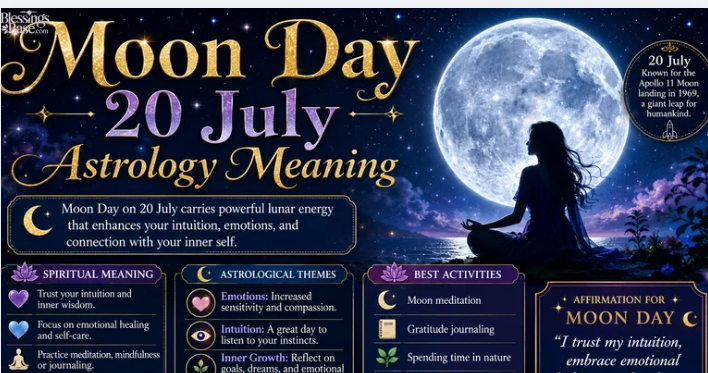
Although Moon Day on July 20 is primarily a historical observance honoring the Apollo 11 Moon landing, some people also explore its symbolic meaning through astrology. It’s important to note that Moon Day itself is not an official astrological event, but the Moon has always played a significant role in astrology and spiritual traditions.
In astrology, the Moon represents:
- Emotions and feelings
- Intuition and inner wisdom
- Relationships and family
- Habits and daily routines
- Mental well-being
- Feminine energy
- Personal growth
Many astrology enthusiasts use Moon Day as an opportunity to reflect, meditate, journal, or set personal intentions while appreciating the Moon’s symbolic influence.
Note: The astrological meaning of July 20 changes each year depending on the Moon’s phase and zodiac sign. Moon Day itself is based on history—not astrology
Is Moon Day Connected to Zodiac Signs?
Not directly.
Moon Day commemorates the Apollo 11 Moon landing, whereas zodiac signs are based on the Moon’s and planets’ positions in the sky.
However, many astrologers believe the Moon influences:
- Emotional balance
- Decision-making
- Creativity
- Relationships
- Self-awareness
- Spiritual reflection
This is why some people combine Moon Day celebrations with meditation, moon journaling, or mindfulness practices.
Moon Day Meaning for Girls
Some people search for “Moon Day meaning for girl” because the Moon has traditionally been associated with feminine qualities in many cultures.
Symbolically, the Moon represents:
- Grace
- Calmness
- Beauty
- Compassion
- Wisdom
- Emotional strength
- Inner peace
- Hope
- Renewal
For girls and women, Moon Day can serve as a reminder to embrace confidence, personal growth, and curiosity while celebrating humanity’s remarkable achievements in science and exploration.
Interesting Moon Day Facts
Here are some fascinating facts about Moon Day and the historic Apollo 11 mission.
If stories of achievement inspire you, don’t miss our <Inspirational Morning Messages> for more daily motivation.
🌕 1. The Moon Landing Happened in 1969
Apollo 11 landed on the Moon on July 20, 1969, making history forever.
🚀 2. Neil Armstrong Was the First Person on the Moon
He became the first human to walk on the lunar surface.
👨🚀 3. Buzz Aldrin Followed Soon After
Buzz Aldrin became the second astronaut to walk on the Moon.
🌍 4. Michael Collins Stayed in Lunar Orbit
While Armstrong and Aldrin explored the Moon, Collins remained aboard the Command Module.
🛰️ 5. Apollo 11 Traveled About 240,000 Miles
The spacecraft traveled roughly 386,000 kilometers from Earth to the Moon.
🌑 6. The Landing Site Was the Sea of Tranquility
This smooth lunar plain was selected for Apollo 11’s historic landing.
📺 7. Millions Watched the Moon Landing Live
The event became one of the largest television broadcasts in history.
🌎 8. Moon Rocks Were Brought Back to Earth
The astronauts collected rocks and soil that scientists still study today.
🔬 9. Moon Day Inspires Future Space Missions
Modern missions such as NASA’s Artemis program continue the dream of lunar exploration.
🌕 10. July 20 Is Celebrated Worldwide
Schools, museums, observatories, and science organizations commemorate Moon Day each year.
Moon Day Quotes
“The Moon reminds us that impossible dreams can become reality.”
“Every giant leap begins with a single brave step.”
“Look at the Moon and remember that curiosity changes the world.”
“The greatest discoveries begin with asking one simple question: What lies beyond?”
“Moon Day celebrates humanity’s courage to explore the unknown.”
Frequently Asked Questions (FAQs)
What is Moon Day?
Moon Day is celebrated every year on July 20 to honor the historic Apollo 11 Moon landing in 1969, when humans first walked on the Moon.
Why is Moon Day celebrated on July 20?
It marks the anniversary of Apollo 11’s successful lunar landing on July 20, 1969, one of the greatest achievements in human history.
Who first walked on the Moon?
Neil Armstrong was the first person to walk on the Moon, followed shortly by Buzz Aldrin.
When was the first Moon Day?
The event that inspired Moon Day occurred on July 20, 1969, while International Moon Day was officially recognized by the United Nations in 2021.
Is Moon Day the same as International Moon Day?
Both are celebrated on July 20. Moon Day traditionally honors the Apollo 11 landing, while International Moon Day is the official global observance established by the United Nations.
Is Moon Day a public holiday?
No. Moon Day is generally observed as an educational and commemorative event rather than a public holiday.
How do people celebrate Moon Day?
People celebrate by watching Moon landing documentaries, visiting museums and planetariums, attending astronomy events, observing the Moon through telescopes, and learning about space exploration.
Final Thoughts
Moon Day is much more than a celebration of a historic mission—it is a tribute to the limitless potential of human curiosity and determination. Every July 20, we remember the bravery of the Apollo 11 crew and the thousands of scientists, engineers, and support teams whose work made the first Moon landing possible.
As new lunar missions and international partnerships shape the future of space exploration, Moon Day continues to inspire people of all ages to dream bigger, explore further, and embrace the spirit of discovery. For more uplifting messages and meaningful celebrations throughout the year, visit our Daily Blessings collection.
Whether you’re fascinated by history, science, astronomy, or simply the beauty of the Moon, this annual observance reminds us that today’s dreams can become tomorrow’s greatest achievements.

I am Brinley, a writer who loves sharing blessings and positive words. I have three years of experience creating meaningful blessings for readers. Nich is the creative mind behind many trending blessings and prayers. Our goal is to spread faith, hope, and kindness online.