
Every year on October 31, streets glow with jack-o’-lanterns, children dress as ghosts and superheroes, and bowls of candy appear at every door. 🍬 But what is Halloween, really, and where did this spooky celebration come from?
The history of Halloween stretches back more than 2,000 years. It begins with an ancient Celtic harvest festival, passes through medieval Christian feast days, and arrives today as one of the most popular holidays in America.
In this guide, you will learn the Halloween origin, the meaning of its name, the most loved Halloween traditions, and honest answers to hard questions like “Is Halloween evil?” 🕯️ Let’s begin.
⚡ Quick Answer: Halloween is an annual holiday celebrated on October 31, the evening before All Saints’ Day. Its roots lie in the ancient Celtic festival of Samhain, later blended with the Christian observance of All Hallows’ Eve. Today it is known for costumes, jack-o’-lanterns, trick-or-treating, and candy.
🎃 What Is Halloween?
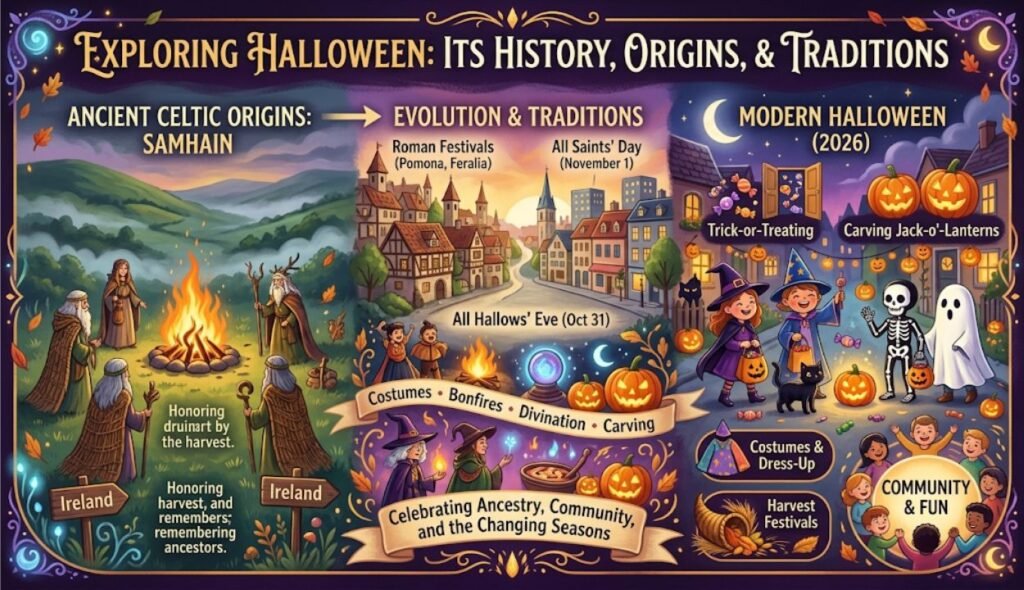
Halloween is a seasonal holiday observed on the night of October 31. The name is a shortened form of “All Hallows’ Eve,” meaning the evening before the Christian feast of All Hallows, also called All Saints’ Day.
The Halloween meaning has changed over the centuries. It began as a harvest and remembrance festival, grew into a night of folklore and ghost stories, and is now mostly a fun community celebration. 🎉
People observe it differently around the world. Some host parties, some carve pumpkins, and some simply turn off the porch light. Others quietly skip it for cultural or religious reasons.
⚡ Quick Answer (One Sentence): Halloween is a yearly October 31 celebration with Celtic and Christian roots, now enjoyed with costumes, pumpkins, and treats.
📌 Halloween at a Glance
- 📅 Date: October 31 every year
- 🏺 Ancient root: Samhain, a Gaelic harvest festival
- ⛪ Christian link: All Hallows’ Eve, All Saints’ Day, and All Souls’ Day
- 🌍 Popular in: the United States, Canada, Ireland, the United Kingdom, and many other countries
- 🍭 Famous customs: trick-or-treating, costumes, jack-o’-lanterns, parties, and haunted houses
📜 What Is the History of Halloween?
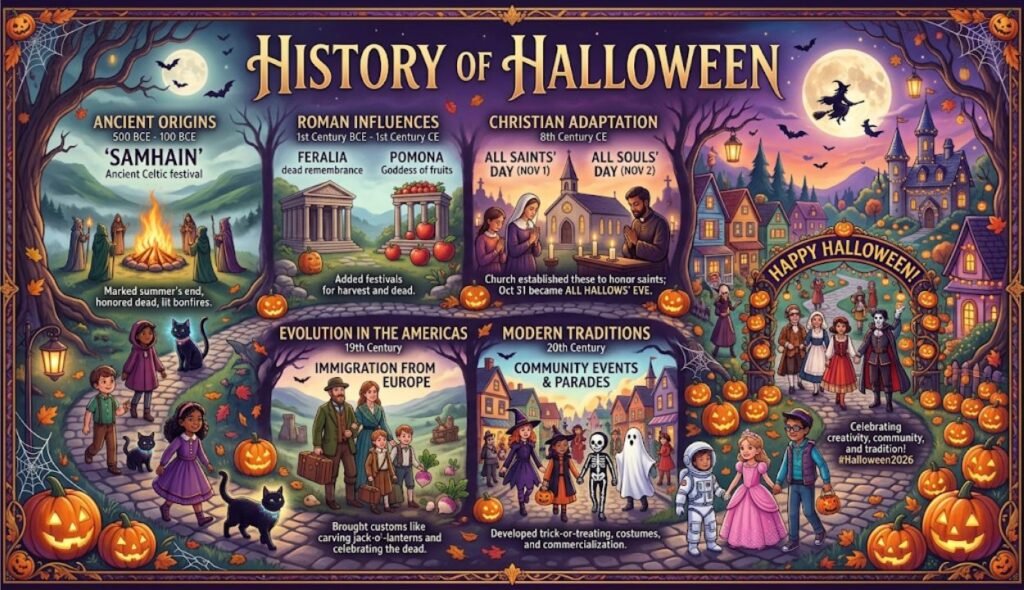
The history of Halloween is a story of three streams meeting: Celtic seasonal festivals, Christian feast days, and later immigrant traditions in North America. No single event created it. 🌊
If you have searched for “Halloween history origin Wikipedia” or “what is Halloween in history,” the short version is this. Halloween grew slowly over about two thousand years. Let’s walk through each stage.
🔥 The Ancient Celtic Festival of Samhain
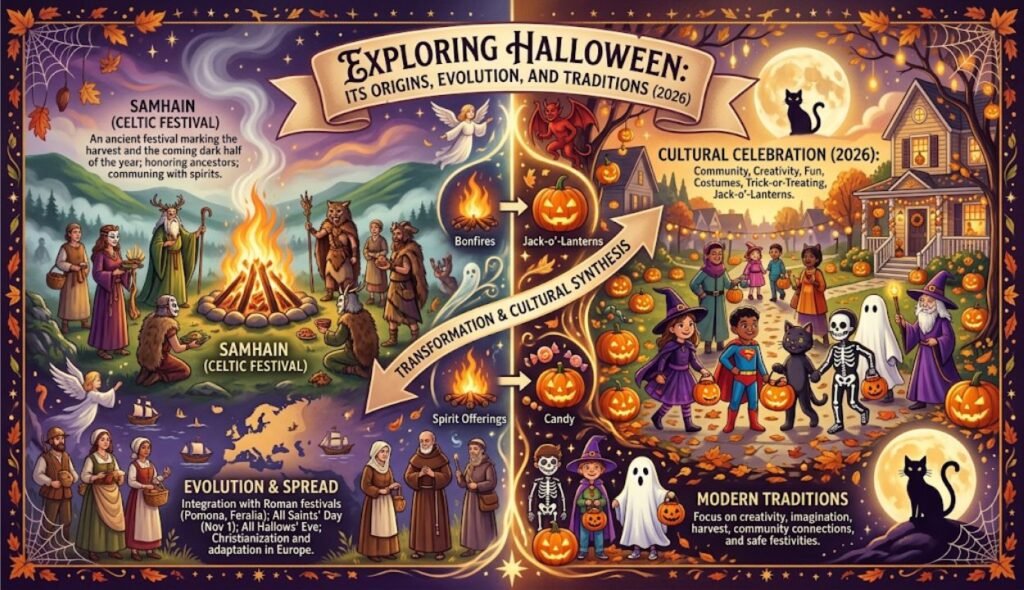
Samhain (pronounced “SOW-in”) was a Gaelic festival marking the end of the harvest season and the start of the dark half of the year. It was celebrated around November 1 in Ireland, Scotland, and the Isle of Man. 🌾
Ancient people believed the boundary between the living and the dead grew thin at this time. Families remembered their ancestors, and many believed spirits could walk among the living. 👻
Bonfires were central to the festival. Communities gathered around fires, shared food, and later carried embers home to relight their hearths. 🔥
Some later accounts mention costumes and disguises meant to confuse wandering spirits. Historians note that much of what we know comes from medieval Irish texts, so some details remain debated.
⛪ How Christianity Influenced Halloween
By the early Middle Ages, the Church honored saints and martyrs with a feast known as All Saints’ Day, or All Hallows. In the 8th century, it became tied to November 1, according to long-standing tradition associated with Pope Gregory III. 📖
The night before became All Hallows’ Eve, later shortened to Hallowe’en. Around the year 998, Saint Odilo of Cluny also promoted All Souls’ Day on November 2 to pray for the departed. 🕊️
Many scholars believe these Christian feasts overlapped with older Celtic customs of remembering the dead. Others argue the connection to Samhain is less direct. Historians still discuss this relationship, so honest writers avoid claiming certainty. ⚖️
🌍 How Halloween Became a Modern Holiday
As Irish and Scottish communities moved across the Atlantic, they carried their autumn customs with them. The mass migration after the Irish Great Famine of the 1840s greatly boosted Halloween’s popularity in North America. 🚢
Early American celebrations focused on harvest parties, ghost stories, fortune-telling games, and playful pranks. Over time, communities steered the night toward safer, family-friendly fun.
By the mid-20th century, costumes, door-to-door candy collecting, and school parties had become standard. 🏫 Today, Halloween in America is a multi-billion-dollar cultural event, yet its simple heart remains community and imagination.
🗓️ Halloween History Timeline
- 🌾 Ancient times: Gaelic communities celebrate Samhain at the end of harvest
- ⛪ 8th century: All Saints’ Day becomes associated with November 1
- 🕊️ c. 998: All Souls’ Day is promoted on November 2
- 📚 1500s to 1700s: “Hallowe’en” appears in Scots and English writing
- 🚢 1840s: Irish immigration spreads customs across North America
- 🍬 1930s to 1950s: Trick-or-treating becomes a widespread American tradition
🌱 What Is the Origin of Halloween?
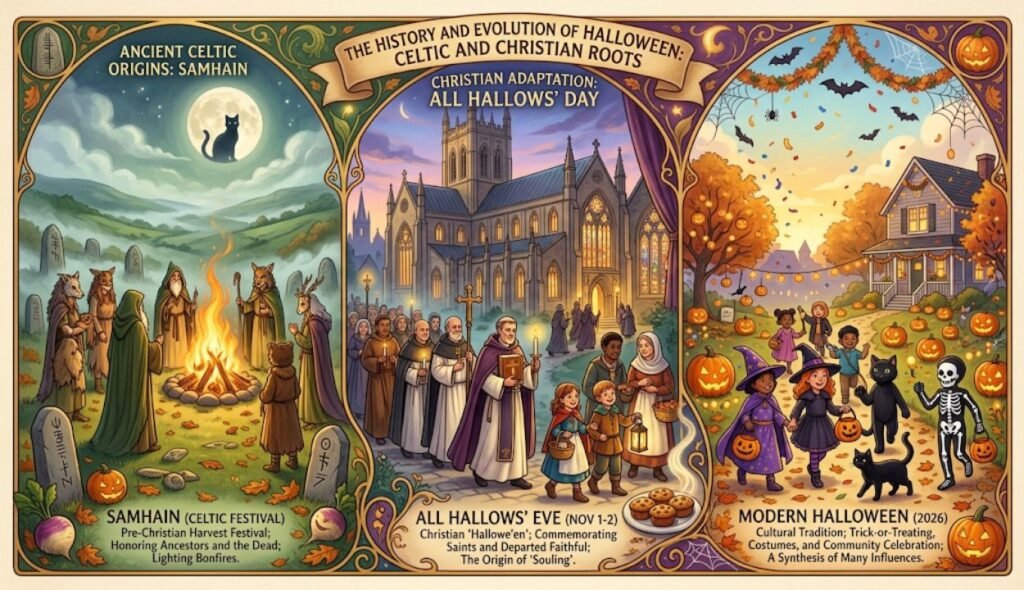
The Halloween origin is usually traced to the Celtic festival of Samhain in the British Isles. This is the most common answer in encyclopedias, museums, and university resources. 🏛️
However, the modern holiday is not a copy of Samhain. It is a blend. Christian feast days gave it a name and date, while folk customs gave it its playful side.
🔤 Where Does the Name Come From?
The word “Halloween” comes from “Hallow-e’en,” short for “All Hallows’ Evening.” “Hallow” is an old English word meaning “holy person” or “saint.” ✨
That is why some readers ask, “What does Helloween mean?” The correct spelling is Halloween. The alternate spelling “Helloween” is a common typo, though it is also the name of a German metal band. 🎸
⚖️ Ancient Samhain vs. Modern Halloween
Samhain was a solemn seasonal turning point tied to farming and ancestors. Modern Halloween is mostly a playful, commercial, and community-centered holiday. 🎭
Both share themes of darkness, death, and the unseen. But the meaning, purpose, and customs are very different today.
⚡ Quick Answer: Where did Halloween originate? Halloween originated in Ireland and the wider Celtic regions of the British Isles. It developed from Samhain and was later shaped by the Christian All Hallows’ Eve.
✝️ Did Halloween Originate in Christianity?
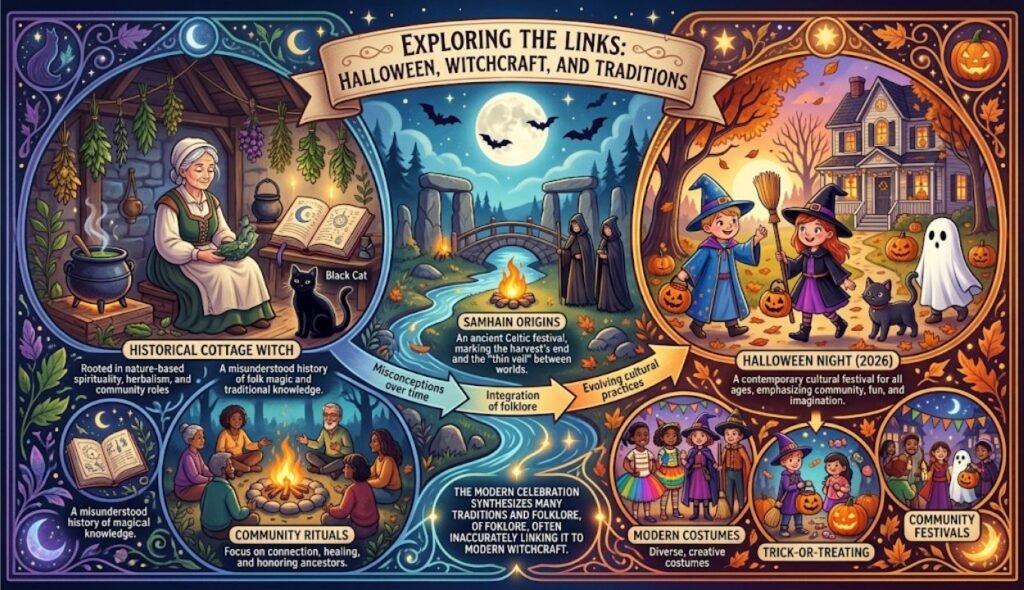
Not entirely. Halloween’s name and calendar position come from Christianity, but many of its customs have older folk or pre-Christian roots. So the best answer is that it is a combination. 🧩
Samhain was a Celtic festival long before the Church adopted November 1 as All Saints’ Day. All Hallows’ Eve, by contrast, is a Christian vigil observed before a major feast.
🕯️ Samhain vs. All Hallows’ Eve
- 🔥 Samhain: a Gaelic harvest and ancestor festival, rooted in seasonal belief
- 🕯️ All Hallows’ Eve: a Christian vigil honoring saints and martyrs
- 🎃 Halloween: the modern cultural holiday that grew from both traditions
📖 All Saints’ Day and All Souls’ Day
All Saints’ Day (November 1) honors saints, known and unknown. All Souls’ Day (November 2) is a day of prayer for the faithful departed. 🙏
In medieval Europe, poor families went “souling.” They knocked on doors, offered prayers for the dead, and received small soul cakes in return. Many writers see this as an early cousin of trick-or-treating. 🍪
🧠 So, Is Halloween Pagan or Christian?
Historians generally describe it as layered. It has pagan Celtic roots in seasonal customs, Christian roots in its name and calendar, and modern roots in American popular culture.
This is why searches like “Halloween origin pagan” and “Halloween dark history” both appear. Each captures only part of the full picture. 🔍
📅 Why Is Halloween Celebrated on October 31?
Halloween is celebrated on October 31 because it is the eve of November 1, which is both All Saints’ Day and the traditional start of Samhain. Ancient Celtic days began at sunset, so the festival started the evening before. 🌇
Christian calendars also count feast days from the previous evening. This is why All Hallows’ Eve falls on October 31.
⚡ Quick Answer: Why October 31? It is the night before November 1, the date linked to both Samhain and All Saints’ Day. Both traditions began their observance at sunset the evening before.
The date also marks a natural turning point. Autumn deepens, daylight shrinks, and the harvest ends, which made it a meaningful moment for communities long ago. 🍂
For many people, October 31 is also Reformation Day, which commemorates Martin Luther’s 1517 theses. Some Protestant churches hold special services that day instead of Halloween events. ⛪
🕰️ When Was Halloween Established?
Halloween was not “established” on one date by one authority. The Christian feast of All Hallows was moved to November 1 around the 8th century, and the term Hallowe’en appeared in print centuries later. 📚
In America, widespread public celebration only took off in the 19th and 20th centuries. So when people ask “when was Halloween celebrated first,” the honest answer is that it evolved gradually. ⏳
🎭 What Are the Most Popular Halloween Traditions?
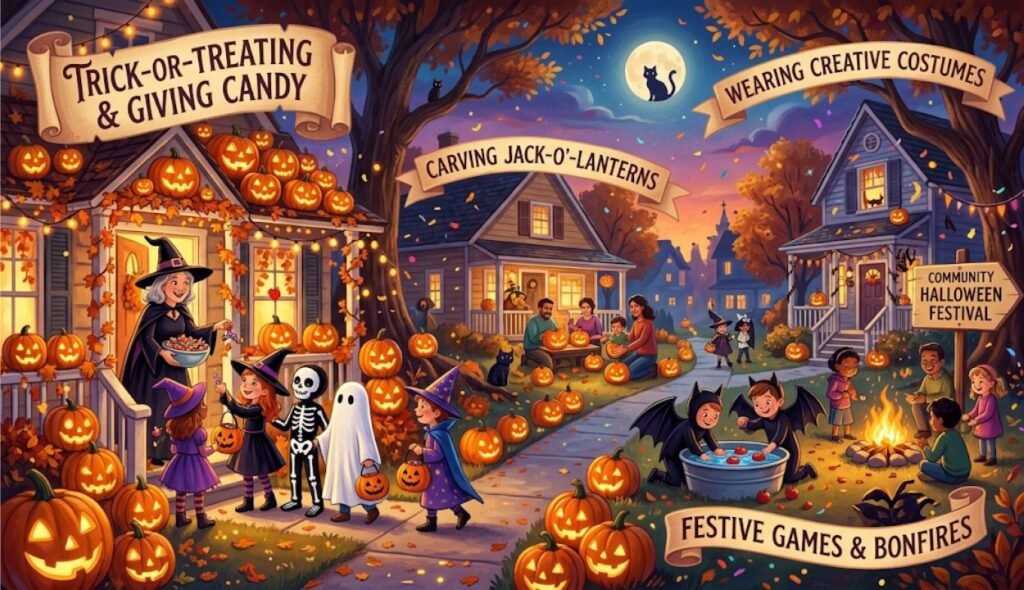
Halloween traditions mix ancient folk habits with modern fun. Each custom has its own backstory, and many began as practical or spiritual practices long before they became games. 🎉
Here are the four most famous ones.
🍬 Trick-or-Treating
Trick-or-treating is when children dress up, visit homes, and collect candy. The custom likely grew from medieval souling and the Scottish and Irish practice of “guising,” where people performed songs or jokes for treats. 🎶
In the United States, the phrase “trick or treat” became popular in the 1930s. By the 1950s, it was a beloved neighborhood tradition. 🏘️
Today, many families also choose trunk-or-treat events at schools and churches. These offer a safe, well-lit alternative. 🚗
👻 Wearing Halloween Costumes
Costumes may trace back to mumming, guising, and the belief that disguises could hide people from restless spirits. Over time, the purpose shifted from protection to play. 🎭
Today’s popular costume themes include:
- 🦸 Superheroes and fictional characters
- 🧙 Witches, wizards, and fantasy figures
- 🧟 Ghosts, zombies, and classic monsters
- 🐱 Animals and cute pet-themed outfits
Need ideas for the season? Our Halloween greetings are perfect for cards, captions, and party invitations. 💌
🎃 Carving Pumpkins and Jack-o’-Lanterns
The jack-o’-lantern comes from an Irish folktale about Stingy Jack, a trickster who fooled the Devil and was doomed to wander with a glowing coal inside a hollowed turnip. 🥔
In Ireland and Scotland, people carved turnips and potatoes to ward off spirits. When immigrants reached North America, they found pumpkins larger, softer, and easier to carve. 🎃
Want creative designs? Explore these cute pumpkin carving ideas, cute pink pumpkin ideas, and cute pumpkin drawing ideas. ✨
🎉 Halloween Parties, Decorations, and Games
Halloween parties are full of themed decor such as cobwebs, skeletons, glowing lanterns, and haunted-house scenes. Many families also decorate with cute pumpkin ideas to keep things friendly and bright. 🕸️
The origin of Halloween games is just as interesting. Apple bobbing, nut-roasting, and fortune-telling games were once used to guess a future spouse. Some writers link apples to the Roman festival of Pomona, though this connection is debated. 🍎
Today’s party staples include costume contests, pumpkin-painting, scavenger hunts, and spooky movie nights. 🎬
🧙 Is Halloween Linked to Witchcraft?
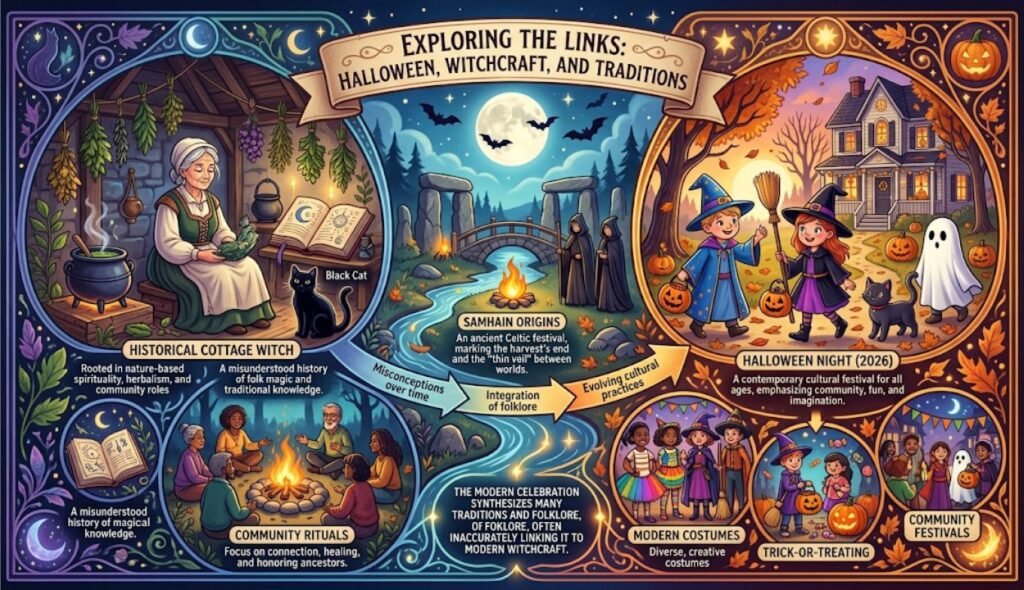
Halloween is linked to witches mostly through folklore and popular imagery, not through documented ancient practice. Witch figures, black cats, and brooms became Halloween symbols largely in the 19th and 20th centuries. 🧹
In older Scottish and Irish customs, Halloween was a favored night for divination games, such as using nuts, apples, or mirrors to guess a future partner. Some people considered these games superstition, and others saw them as harmless fun. 🔮
It helps to separate three things: historical folk belief, modern Hollywood imagery, and actual religious practice. Today, some followers of modern Wiccan and neo-pagan paths observe Samhain as a sacred day. Most people, however, celebrate Halloween with no spiritual meaning at all. 🌙
⚡ Quick Answer: Is Halloween linked to witchcraft? Partly in folklore and imagery, yes. But most modern celebrations are secular, and the idea of an ancient “witch festival” is not well supported by historians.
📖 What Does the Bible Say About Halloween?
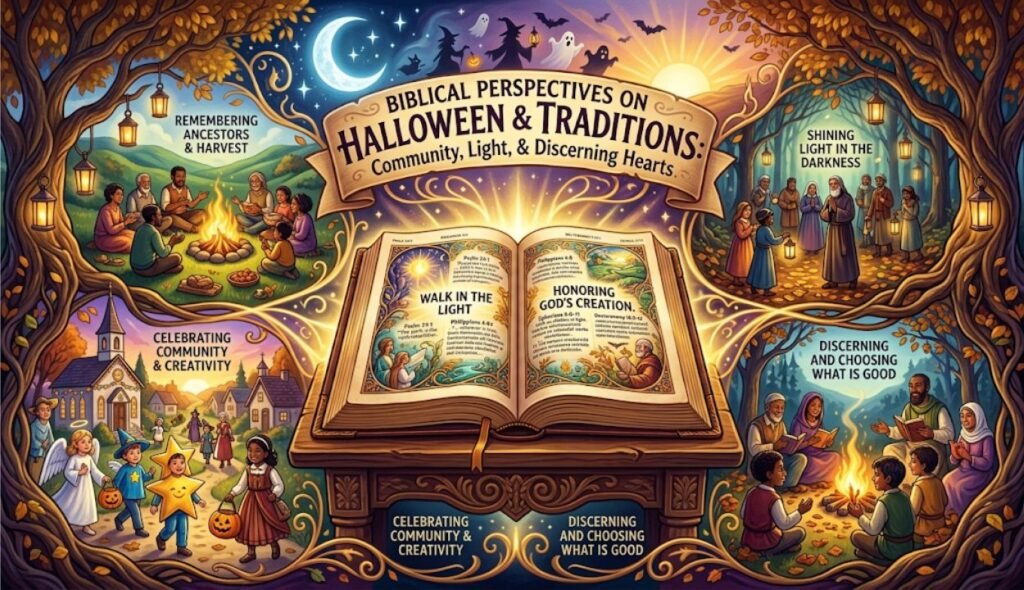
The Bible does not mention Halloween by name. The holiday did not exist when the biblical books were written, so any answer to “what does Halloween mean in the Bible” must come from principles, not direct verses. 📜
Christians who avoid Halloween often point to passages warning against occult practices, such as Deuteronomy 18:10-12, which condemns divination and consulting spirits. Others cite Ephesians 5:11, which encourages believers not to take part in “unfruitful works of darkness.” ⚠️
Christians who join in usually argue that candy, costumes, and neighborhood fun are not occult acts. They often cite Romans 14, which teaches respect for differing convictions on disputed matters. 🤝
🙏 What Does God Say About Halloween?
Scripture gives no direct command about the holiday. It does give broad guidance: test everything, hold to what is good, and act from a clear conscience (1 Thessalonians 5:21). ✅
Many believers pray over the decision and follow their church’s teaching. If you are looking for calm and guidance this season, you may enjoy our prayer for myself and prayers for peace. 🕊️
💐 Why Do Christians Disagree?
- 🙅 Avoid it: Some feel the themes of death, ghosts, and witches conflict with their faith
- 🤝 Join in: Some view it as harmless community fun and a chance to meet neighbors
- ⛪ Redirect it: Some host harvest festivals, fall carnivals, or Reformation Day events
- 🕊️ Honor saints: Some focus on All Saints’ Day instead
The Bible does not settle this question in one verse, so respectful conversation matters more than winning an argument. 💛
😈 Is Halloween Evil or Demonic?
Whether Halloween is evil depends on personal belief, religious teaching, and cultural background. There is no single universal answer, and honest writers should say so. ⚖️
For many families, Halloween means pumpkins, costumes, candy, and time with neighbors. These activities are not explicitly religious or occult. 🍬
Others hold sincere convictions that its imagery of death and spirits is spiritually unwise. Those views deserve respect, just like the views of people who enjoy the holiday. 🤲
⚡ Quick Answer: Is Halloween evil, yes or no? There is no single yes or no. Many people see it as harmless cultural fun, while some religious groups choose not to take part. Your decision is personal.
🔍 What About the “Halloween Dark History”?
Halloween does carry some darker historical themes, including death, the afterlife, and fear of spirits. Early American Halloween also included pranks and vandalism, which led communities to promote organized parties. 🚨
Even so, “dark” does not automatically mean “evil.” Many holidays, such as All Souls’ Day and Día de los Muertos, deal openly with death and memory. 🕯️
🚜 Do the Amish Celebrate Halloween?
Most Amish communities do not celebrate Halloween in the typical way. They tend to view it as a worldly custom that does not fit their simple, faith-centered lifestyle. 🏡
However, practices can differ between settlements and church districts. Each community follows its own Ordnung, the set of local rules. Some families may allow children to enjoy harvest-themed fun or carve pumpkins without observing Halloween itself. 🌽
That is why it is best not to assume every Amish community behaves the same way. 🤝
🇮🇪 Is Halloween Irish or Mexican?
Halloween is historically Irish and Celtic, not Mexican. Its roots lie in Samhain and the customs of Ireland, Scotland, and the Isle of Man. ☘️
Mexico’s Día de los Muertos is a separate tradition. It blends Indigenous Mesoamerican beliefs with Catholic influences from Spain. 🇲🇽
The two holidays happen around the same dates and both remember the dead, so people often mix them up. But their history, tone, and customs are quite different. 🎨
⚡ Quick Answer: Is Halloween Irish or Mexican? Halloween is Irish and Celtic in origin. Día de los Muertos is a Mexican tradition with its own separate history.
🆚 Halloween vs. Día de los Muertos
- 🎃 Mood: Halloween is playful and spooky; Día de los Muertos is warm and honoring
- 📅 Dates: Halloween is October 31; Día de los Muertos is November 1 and 2
- 🌼 Symbols: pumpkins and costumes versus marigolds and ofrendas
- 👨👩👧 Focus: fun and fright versus family remembrance
🌎 What Do Latinos Call Halloween?
Many Spanish speakers simply say “Halloween.” In several Latin American countries and in Spain, it is also called “Noche de Brujas,” meaning “Night of the Witches.” 🧙♀️
Names vary by region, and not every community celebrates it. In some places, the holiday is a recent import from the United States, especially in cities and schools. 🏙️
It is important not to confuse Halloween with Día de los Muertos. The Day of the Dead is not a “Mexican Halloween” but its own cultural and spiritual observance. ❤️
💀 What Is Mexico’s Version of Halloween?
Mexico’s closest counterpart is Día de los Muertos, or Day of the Dead, observed on November 1 and 2. It is a joyful holiday of remembrance, not a scary one. 🌺
Families build ofrendas, which are home altars decorated with photos, candles, favorite foods, and bright orange marigolds called cempasúchil. The flowers and candles are believed to guide spirits home. 🕯️
Common traditions include:
- 🌼 Marigolds: their color and scent guide souls to the altar
- 🍞 Pan de muerto: a sweet bread shared in honor of the departed
- 💀 Sugar skulls: colorful treats and decorations that celebrate life
- 🎶 Music and stories: families gather at cemeteries to remember loved ones
UNESCO recognizes the Indigenous festivity of the Day of the Dead as Intangible Cultural Heritage. Its tone is loving, which is a big difference from Halloween’s spooky mood. 🏛️
🗺️ Which Countries and Cultures Do Not Commonly Celebrate Halloween?
Halloween’s popularity varies widely by country, religion, and community. It is most common in the United States, Canada, Ireland, and the United Kingdom, and it is growing in parts of Europe and Asia. 🌍
It is less common in places where local customs, religious teaching, or government policy discourage it. Some Muslim-majority countries, parts of Orthodox Christian regions, and many conservative religious communities do not widely celebrate it. 🕌
That said, it is unfair to claim that an entire nationality never celebrates Halloween. Even in places where it is uncommon, expatriates, schools, and younger people may still take part. 🌐
Many cultures have their own autumn or remembrance festivals instead. Examples include Obon in Japan, Qingming in China, and Pchum Ben in Cambodia. 🏮
🧠 Halloween Facts You Should Know
- 📅 Halloween takes place every year on October 31
- 🔥 Its historical roots are associated with the Celtic festival of Samhain
- 🕯️ The name comes from the phrase “All Hallows’ Eve”
- 🥔 Jack-o’-lanterns were first carved from turnips in Ireland
- 🎃 Pumpkins became the favorite carving choice in North America
- 🍬 Trick-or-treating became widespread in the United States by the mid-20th century
- 🌍 Modern Halloween blends Celtic, Christian, and American cultural influences
❓ Frequently Asked Questions About Halloween
🕵️ What is the real story behind Halloween?
The real story is a gradual blend. It began with the Celtic festival of Samhain, merged with Christian feasts for saints and souls, and then grew into the playful American holiday we know today. 📜
💬 What is the original meaning of Halloween?
The original meaning was seasonal and spiritual. Samhain marked the end of harvest and honored ancestors, while All Hallows’ Eve prepared believers to honor saints. 🌾
⏳ When did Halloween first begin?
There is no single start date. Samhain is thousands of years old, All Saints’ Day moved to November 1 in the 8th century, and the modern Halloween as we know it formed over the last 200 years. 📆
✝️ Did Halloween originate in Christianity?
Not fully. Its name and date come from Christianity, but its folk customs have Celtic and pre-Christian roots. 🧩
⚖️ Is Halloween evil, yes or no?
There is no universal answer. Beliefs differ, and many people treat it as harmless fun while others choose not to take part. 🤝
📖 Does the Bible say Halloween is demonic?
The Bible never mentions Halloween. Christians draw different conclusions from verses about the occult and about Christian freedom. 🙏
🧙 Is Halloween linked to witchcraft?
It is linked through folklore and imagery, but most modern celebrations are secular and cultural. 🌙
🎭 Why do people wear costumes on Halloween?
Costumes likely began as disguises to avoid spirits, along with the customs of mumming and guising. Today, they are mainly a fun way to express creativity. 🦸
🎃 Why do people carve pumpkins on Halloween?
The tradition comes from Irish jack-o’-lanterns carved from turnips to ward off spirits. Immigrants later switched to pumpkins in North America. 🥔
🇲🇽 Is Halloween Irish or Mexican?
Irish and Celtic in origin. Mexico has Día de los Muertos, a different holiday. ☘️
💀 What is the difference between Halloween and Día de los Muertos?
Halloween is playful and spooky, held on October 31. Día de los Muertos is a loving family remembrance held on November 1 and 2. 🌼
🎸 What is the history of Helloween?
“Helloween” is a common misspelling of Halloween, and it is also the name of a German metal band. The holiday itself is spelled Halloween, with the history covered in this guide. ✅
🔗 Related Reads for Your Autumn Season
Enjoy more seasonal inspiration from our site:
- 💌 Halloween greetings for cards, captions, and messages
- 🎃 Cute pumpkin and cute pumpkin ideas for decorating
- 🍂 Fall season in USA to explore American autumn traditions
- 🍁 Welcome October quotes and wishes to start the month
- 🌟 Hello October blessings and happy October wishes
- 🕊️ Prayers for peace and daily blessings for a calm heart
- 🙏 Count your blessings quotes for gratitude all season
✅ Conclusion: Understanding Halloween’s Real Story
Halloween began as a Celtic harvest festival, took its name from a Christian vigil, and grew into a modern celebration shaped by immigrants and popular culture. It is a layered holiday with many roots. 🌳
Its meaning varies from person to person. For some it is a night of fun, for others a time of remembrance, and for some a day to skip entirely. 💛
Understanding the history of Halloween helps you appreciate how traditions change over time, and it lets you talk about the holiday with respect for every point of view. 🎃
Sources for further reading: NASA’s overview of Halloween history, the Library of Congress guide to Halloween traditions, and Encyclopaedia Britannica’s entry on Halloween.

I am Brinley, a writer who loves sharing blessings and positive words. I have three years of experience creating meaningful blessings for readers. Nich is the creative mind behind many trending blessings and prayers. Our goal is to spread faith, hope, and kindness online.